Preparation
Overview
Preparing for the session to come is a critical component of our trading success, if we have no plan or routine that we go through each morning and we expect to win in the most competitive environment known then we should take our money and light it on fire because it would be faster and take up less time. That is how critical preparation is. Here’s a breakdown of how I prepare for each session and for clarity this is AFTER I have done my 4 hour workout, ice bath, reading 1 book and cooked my Michelin rated breakfast.
Develop Context for Potential Range and Price Action
When it comes to preparation, context rules. The market does everything in context to the broader picture, sometimes macro events matter, sometimes they don’t, sometimes markets care about bond auctions and sometimes they pretend that they do (chill out macro dorks), what is important for trading intraday is to recognize your environment and even more importantly being able to recognize when something has materially changed.
Here’s my short list
Relative Volume - RVOL (a study available on many platforms)
Average Daily Range - ADR (for calculation I use RTH 7 day average daily ranges only)
Overnight Session
/VX and Rotation Size (rotations as calculated from harmonic 3/4 sequence fractals)
Range Summary
We use the information above to get a sense of what to expect in terms of range, volatility, and price action. This factors into our sizing on initial entry and can affect how we execute trades for TP.
For example with large expansion and high volatility we start with smaller size and wider initial risk, scaling into positions in wider ranges (within our risk limits). We also look for potentially larger moves for TP under these conditions.
On the opposite end of the spectrum with tighter ranges we scale in slower to positions and we look for smaller moves and faster TP schemes.
Establish Context
Balance / Imbalance
We are going to cover this in more detail but, I’m looking for clues from the higher timeframe where we are from a balance perspective. Where are my balance levels and what does it mean for the market if it attempts to break away vs what does it mean if it tries and fails? Having awareness of this simple idea is going to give you a much better idea of identifying current state vs a change in state and as I said previously, knowing when things have changed is just as important as knowing what the current state is.
Note / Markdown Key Levels
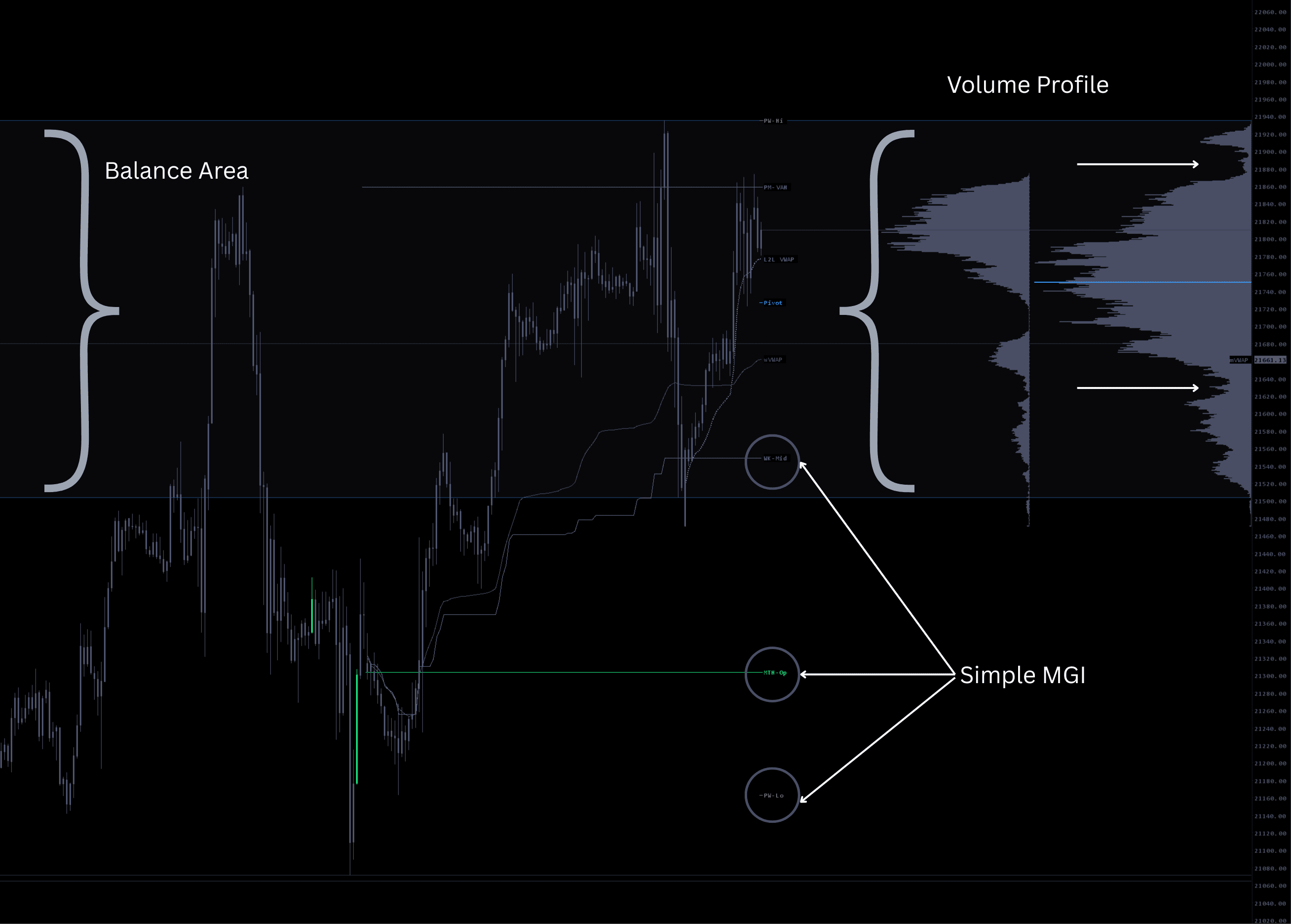
Levels & Context Summary
If we were to breakdown the current HTF view as of 6/8/25, we are at the upper range of current balance area with a well defined low volume node at 21880, notice also the huge volume node on the second profile (from right to left), I look at this as we are building interest (lots of participation) and the LVN marking an area of resistance right near top of balance and last weeks high.
How I would trade this would be very simple.
If we break 21880 to the upside with volume I am looking to trade with the direction upwards and if we that move accelerates I am know AWARE that something has changed because we have spent prior session building volume at the top of a range and IF we then break from that range. I would also be looking for 940s for signs of rejection, its the top of balance and last weeks high, if we fail there its significant in the sense that we tested a big area and found sellers. However, if there’s no response, hmm its party on for longs and looking for a decent break from the range is not out of the question.
On the other side of the spectrum, in this volume build we have a nice shelf around 21780, if we get below that my internal alarm bells are going off for the idea that this entire build of volume is a big range of higher timeframe absorption and that I should be looking for scenarios to sell.
In about 5 minutes or less I have given myself a solid if than scenario for the upcoming session, if x happens I will respond with y and context clues I will look for will be Z to happen. If Z doesn’t happen my spidey senses kick in enough to give me pause so I can re evaluate. Being properly prepped doesn’t need to be scienced to death. Give yourself some basic areas of interest that are built on a logical and fundamental understanding of how markets work and then narrate a story to yourself with key inflection points.
Putting It All Together
Range Expectations
Context and Narrative
Key Levels & HTF Analysis
Econ Releases
Final Thoughts
By now we should have ideas about how to approach our sizing and trading strategy for the session. We have reviewed the context and narrative and have gone through key levels and HTF analysis. We have a couple spots we will be monitoring right when the market opens, and will remain flexible about making adjustments on the fly if we see something significant and last but not least, we are aware of all potential market moving economic data releases.